



Most policy discussions about sustainability focus on emission targets, biodiversity commitments, or climate finance. A new report from Global Footprint Network and Greenings, “Prepared for the Predictable? Overshoot and the Failure of Countries to Ready Themselves,” takes a different angle. It asks whether the economic strategies of national governments (the documents that set budget priorities and structural direction) treat resource security and ecological overshoot as significant factors in planning. The findings, and the method used to reach them, may be of interest to professionals concerned with national strategy, risk assessment, or policy analysis.
The underlying concern
The report’s starting premise is straightforward. Economic activity depends on physical inputs: energy, minerals, water, cropland, timber, and the physical ability to deal with the associated wastes, like carbon emissions from fossil fuel use. GDP tracks the monetary flows built on top of these inputs, but it does not track the inputs themselves. Global Footprint Network has argued for decades, through its Ecological Footprint, biocapacity accounting, and annual marker of Earth Overshoot Day, that current global demand for renewable resources exceeds what ecosystems can regenerate, a trend that has repeated itself, year after year, since the early 1970s.
The environmental impact of overshoot compounds over time, and its implications reach well beyond ecological erosion. Left unaddressed, overshoot feeds stagflation, conflict, and economic disruption.
These disruptions are symptoms, not the underlying problem. The resource shocks themselves are not what should worry policymakers most; what should worry them is the systemic fragility they expose in resource-overdependent economies. That fragility is already translating directly into economic pain. Russia’s invasion of Ukraine disrupted agricultural exports and energy supply chains worldwide. The closure of the Strait of Hormuz this year removed, as widely reported,[1] roughly a fifth of global oil shipping overnight.
What the report sets out to measure
Rather than assess environmental performance or emission pathways, the report asks a narrower and more policy-relevant question: to what extent do national governments recognize resource security and overshoot risk in the documents that define their central economic priorities, and how does that recognition translate into binding action?
To answer this, the researchers selected a set of major economies and, for each, identified what they call Tier 1 documents: the documents that most authoritatively express a country’s overarching strategic agenda. The criteria for selecting documents included whether they originate from the highest executive or financial authority, whether they mandate a whole-of-government shift, and whether they explicitly articulate national objectives and priorities. This produced a working set of documents ranging from national development plans and five-year plans to budget speeches, national security strategies, and legislative acts, drawn from a diverse mix of countries by region, income level, and resource profile.
Methodology: a five-dimension rubric applied by multiple models
The core methodological contribution is a structured scoring rubric built around two axes. Axis 1 measures the extent to which a strategy recognizes overshoot as a threat, broken into three dimensions: biophysical risk recognition (whether the strategy ties economic planning to physical resource limits), economic risk recognition (whether resource deficits are treated as a threat to fiscal stability or credit), and prominence (how visible this language is within the document’s core sections, as opposed to being confined to footnotes or sector-specific annexes). Axis 2 measures the extent to which a strategy demonstrates an actual response, broken into two dimensions: governance and enforcement alignment (whether recognized risks are matched by binding, funded policy rather than aspirational language), and biophysical trajectory (whether investment and industrial planning show a genuine shift toward resource security rather than continued expansion of extraction and throughput). Each dimension is scored from 0 to 1 in increments of 0.25 against five qualitative levels, from full disregard to full alignment.
Documents were evaluated by four separate large language models, each applying the identical rubric and standardized prompt independently. This is the detail most relevant to methodology-minded readers: rather than having a small team of human analysts apply the rubric, which introduces fatigue and inter-rater inconsistency over dozens of lengthy documents, the researchers used model agreement as a consistency check. The models converged closely on their conclusions, with disagreement rarely exceeding a small margin on the 0 to 1 scale, which the authors take as evidence that the rubric is measuring something reasonably well-defined rather than reflecting idiosyncrasies of any single model. The authors are candid about the limitations of this approach: it depends on careful prompt design, does not eliminate the possibility of model bias, and has not been validated at scale against human expert scoring. They cite ongoing work, including multi-stage validation, structural anchors, and explicit reasoning requirements, aimed at mitigating known failure modes such as persuasion bias in model outputs.
At the same time, such systematic evaluation, as done by the Large Language Models, also eliminates the many potential shifting human biases when evaluations are performed. There still may be bias in the model, but it is equally and consistently applied to every evaluation.
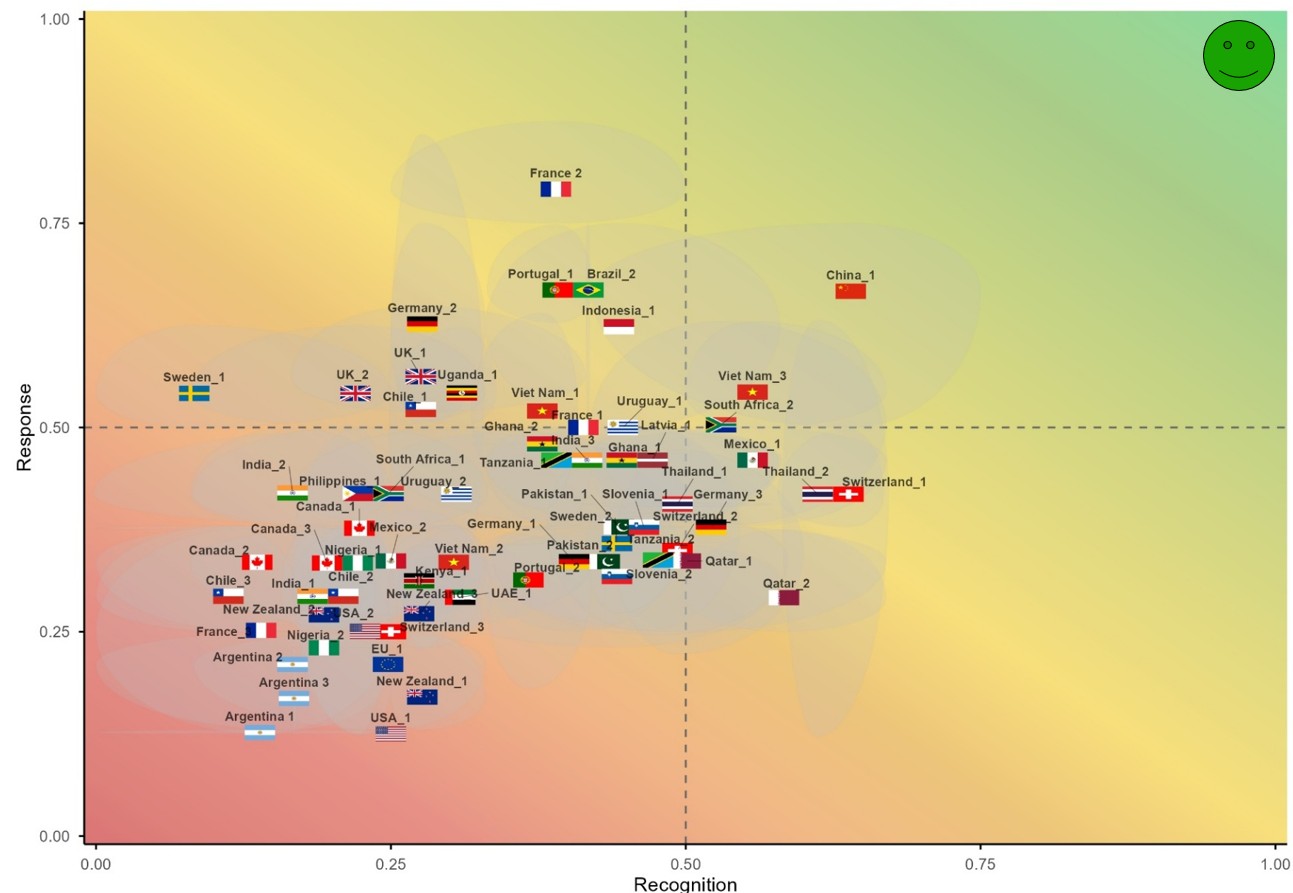
Figure 1: This shows the extent to which countries’ strategies recognize (x-axis) and respond to (y-axis) overshoot. The green smiley face in the upper right corner indicates where strategies need to be to meaningfully recognize and respond to overshoot.
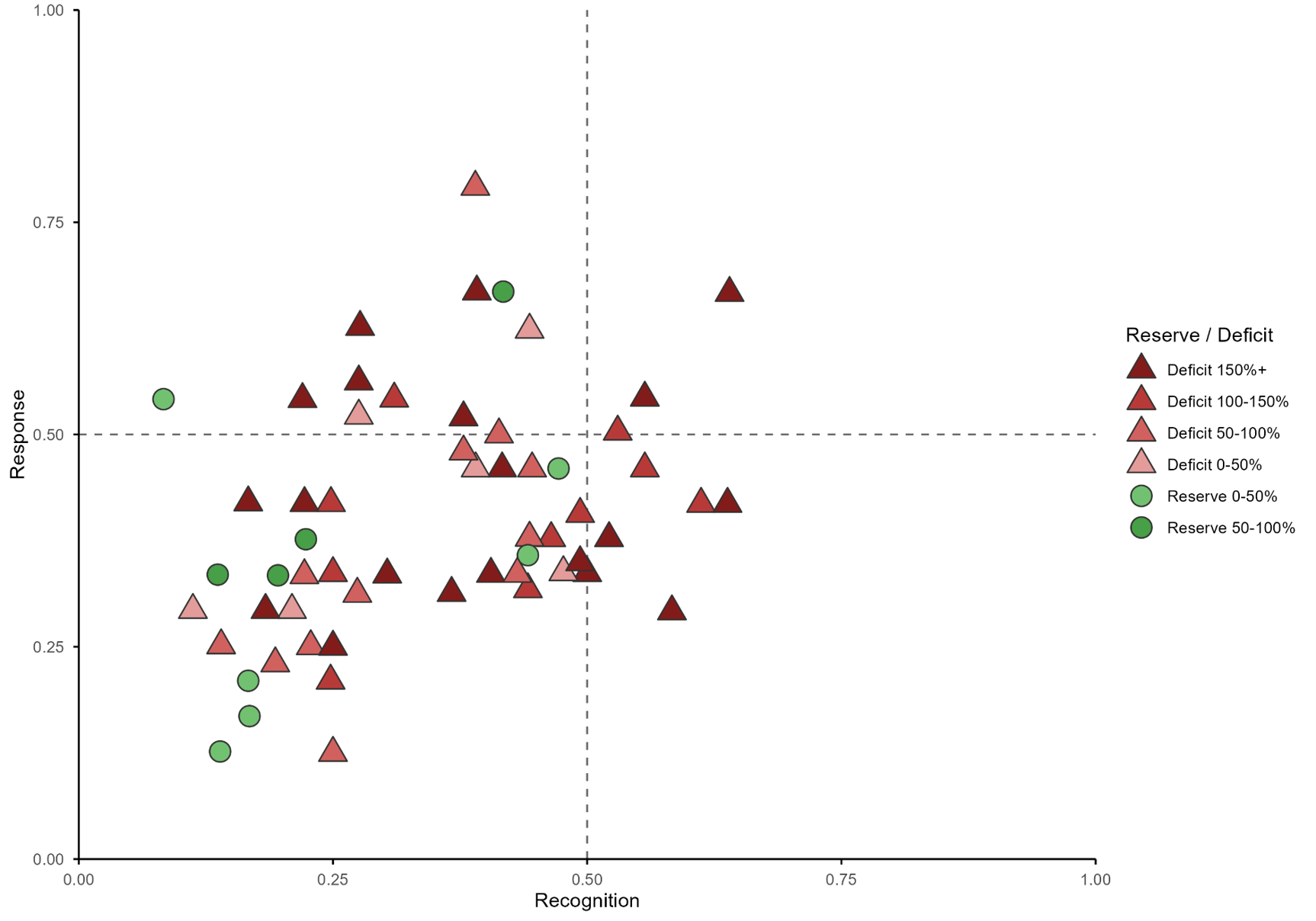
Figure 2: This figure identifies the resource situation for the country of each strategy, again organized by the extent they recognize (x-axis) and respond to (y-axis) overshoot. The red triangles represent countries with biocapacity deficit, and the darker the color, the higher the deficit. For details, consult the full report.
Key findings
Across the sample, no country’s strategy document reaches alignment on both axes with what overshoot response would require. This is shown in Figure 1. The report frames this as evidence of a broad, structural gap between economic self-interest and current strategic planning, rather than an isolated failing of any one government.
Some patterns stood out. China’s current five-year plan positioned itself closest to the upper-right quadrant of recognition and response combined, though still short of full alignment. Switzerland, as Viet Nam, has published different strategy documents which diverge sharply from each other, indicating inconsistent treatment of the issue across a single government’s own output. Argentina scored at the low end. The European Union’s own strategy materials scored lower than might be expected given its prominent climate and sustainability reporting initiatives. This difference might suggest a gap between sustainability communication and structural integration of resource constraints into core economic planning.
The report also provides a public Gemini Notebook Workspace that allows anyone to query the results more fully.
Why this matters for policy analysis
For policy audiences, the value of this report lies less in any single country’s score and more in the framework itself: a replicable, criteria-based method for auditing whether a government’s stated strategic priorities are internally consistent with the physical constraints its economy operates under. The authors are explicit that this is an initial, proof-of-concept assessment intended to be expanded, and that the underlying analysis, including the full reasoning behind every score, is available for independent scrutiny through a Gemini Notebook Workspace with a queryable interface built on all the model outputs. That transparency is itself a methodological choice worth noting: rather than presenting scores as a finished verdict, the report positions them as a starting point for further interrogation, by researchers, policymakers, and the public.
The report’s recommendation is correspondingly modest and procedural rather than prescriptive: that governments establish cross-partisan task forces to map their resource dependencies and financial exposure, and that this exercise is a matter of basic institutional due diligence rather than a specific policy prescription. Whether or not one agrees with the report’s framing of overshoot as a central risk category, the methodology it introduces, a transparent rubric applied consistently across a large and heterogeneous document set, offers a template that could reasonably be adapted to audit other blind spots in national strategic planning.
This blog was authored by David Lin, Mathis Wackernagel, Kristin Kostka, and Dennis West
Additional Resources:
♥ Download full report
♥ A summary for policy analysts. Here a Spanish version/ Español. Here a German version / Deutsch.
♥ Technical Methodology which describes the process of the evaluation and documents the prompts used
♥ A summary for the general public
♥ A blog on the AI-based research methodology behind the report
♥ The electricity footprint of this AI study
♥ A blog on the report’s conclusions
♥ Access to a Gemini Notebook where you can query the LLM outputs for each country. This one is useful for finding out what the LLM evaluation found, without the expectations or perspectives provided by further context. This helps to test what the LLMs found on their own.
♥ Access to a Gemini Notebook where you can query all the information embedded in more context, as the output is enriched with the researchers’ previous publications and perspectives, as the LLM output is enriched with the researchers’ previous publications and perspectives. This one should be more useful for inquiries that have also an interpretation dimension, for instance who want to know more about the rationale behind the analysis.
♥ Earth Overshoot Day 2026 press release [also available in German, Spanish, Dutch, French]
♥ Prepared for the Predictable? press release
[1] https://www.congress.gov/crs-product/R45281; https://www.bbc.com/news/articles/c78n6p09pzno or https://www.brookings.edu/articles/from-chokepoint-to-crisis-the-strait-of-hormuz-and-global-oil-markets/