


The Electricity Footprint of our Study
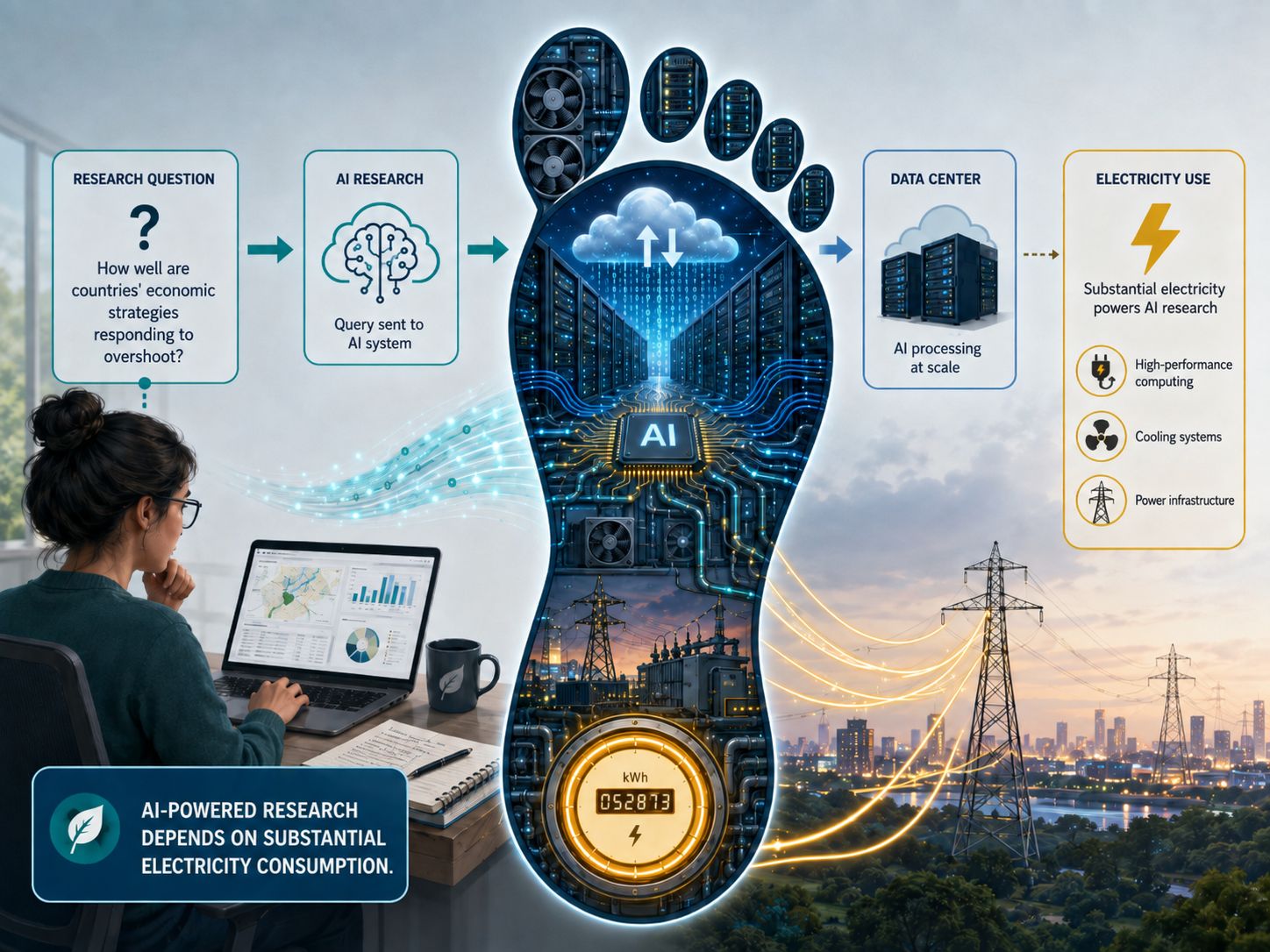 The AI-supported research for Prepared for the Predictable? was conducted over a two-month period. The analysis relied on four AI models used sequentially. Importantly, we did not use paid subscriptions or access to the latest frontier models; instead, the research was carried out using older, publicly available models.
As a result, the computing resources required for this work were likely well below the levels currently available to paying users, even under basic subscription plans. Also, the four LLMs were used sequentially.
Current estimates suggest that large language models (LLMs) use roughly half of their energy consumption for training and the other half for inference and user applications. To account for the full energy footprint of AI systems, estimates of application-related energy use should therefore be approximately doubled to include training costs.
What AI typically uses
Gemini reports the following electricity consumption levels, and other searches with different engines yielded very similar results:
A $20/month basic membership (like ChatGPT Plus , Claude Pro , or Gemini Advanced ) uses roughly 0.1 to 1.5 kilowatt-hours (kWh) of electricity per month for an average user. This assumes about 20 to 50 daily text prompts, where each query consumes about 0.24 to 0.34 watt-hours (Wh). Heavy coding or long document analysis can push this higher. [1, 2]
Energy Use Per Query
- Google Gemini: Uses about 0.24 Wh per median text prompt.
- ChatGPT / Claude: Use about 0.3 to 0.34 Wh per standard text prompt.
- What that means: One query uses about as much energy as running an LED lightbulb for two minutes or watching TV for nine seconds.
Monthly Totals Based on Use Style
- Light User (10 prompts/day): ~0.1 kWh per month.
- Average User (40 prompts/day): ~0.4 kWh per month (equivalent to charging a smartphone roughly 50 times).
- Heavy User / Coder (200+ prompts/day or coding tools): 2.0 to 15+ kWh per month if using massive context windows or continuous agent sessions.
[1] https://www.ecoflow.com/us/blog/ai-energy-consumption-chatgpt-claude-gemini
[2] https://www.earthday.org/the-true-price-of-every-chatgpt-prompt/
What this means for our research
Over the two-month research period, our AI use was modest and likely below that of a heavy user, amounting to less than 2 kWh of electricity per month. Since we used the four LLM models sequentially, we only count them as one use. Including an allowance for the energy required to train the AI models, the total electricity footprint of the research is estimated at less than 8 kWh.
To put this in perspective, an Energy Star-certified refrigerator in the United States consumes about 490 kWh per year on average. At that rate, our entire research project used less electricity than a refrigerator consumes in six days.
Another comparison is electric vehicle travel. A Tesla Model 3 or a LEAF electric car typically travels about four miles per kWh. At that efficiency, 8 kWh would power roughly 32 miles of driving. In other words, a 32-mile trip in such an electric car would consume more electricity than the AI-supported research for this project.
Is this energy use assessment accurate?
We are not sure, and therefore dug a little deeper. We still found much evidence that broadly supports our estimates above, though there is still uncertainty. We have documented our further explorations here.
One reader pointed us to Alex de Vries’ research, published a few years ago, which suggests higher electricity consumption for AI systems than some more recent estimates. So does Hausfather when analysing heavy AI use. However, our lighter use plus technical improvements in language models and hardware over the last years may have reduced the energy required per token generated. Nevertheless, since AI is quite electricity intensive, we will continue to investigate this question, so we can offer a more accurate understanding of the energy demands associated with AI-supported research.