


Twenty years after its launch, the Happy Planet Index is heading into classrooms. Eric Barberà Mas of Hot or Cool explains why, and how the Ecological Footprint makes it possible.
What if we judged a country’s success not by how much it produces, but by how well its people live and how lightly they tread on the planet? That question drives the Happy Planet Index (HPI), a leading alternative to GDP. In July, Hot or Cool published its 7th edition. October 2026 marks the HPI’s 20th anniversary. For this we offer a webinar, looking back at two decades of impact and ahead to its next chapter: schools.
Good lives that don’t cost the Earth
GDP tells us how much an economy produces, not whether people are better off. The HPI asks a more fundamental question: how well do we live, and at what cost to the planet?
It measures wellbeing per unit of ecological resources: how efficiently countries turn the planet’s resources into long, happy lives. The Ecological Footprint, developed by Global Footprint Network, is central to this approach. It tracks how much of nature’s regenerative capacity people’s lives demand, and lets us assess whether wellbeing is achieved within the Earth’s ecological limits. This brings social justice into the picture. If planetary resources are finite, how can we ensure that everyone has a fair share?
The HPI keeps things simple, using just three indicators: life expectancy, experienced wellbeing and the Ecological Footprint. For the Ecological Footprint, it uses the national data provided by FoDaFo. Using these three inputs, it connects the resources we use (inputs) with the wellbeing we achieve (outcomes). Conditions that make good lives possible, such as education, good governance and access to housing, are not in the formula itself, yet they are what make high scores possible. Because it is so simple, the HPI is not only a measure but also a powerful communication tool: it challenges how policymakers define success and what citizens aspire to.
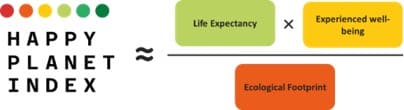
Figure 1: How the HPI is calculated: life expectancy times experienced wellbeing, divided by Ecological Footprint
The latest edition questions the widely held belief that we need high levels of consumption to live well. For the first time, we calculated HPI scores for individuals, not just countries, using survey data from 11 European countries. The findings show that some people enjoy high wellbeing with a relatively low Footprint. Our lifestyles matter, but individual responsibility is only part of the story. We are all embedded in economic systems and social norms that can be difficult to escape. This opens up bigger questions. What kind of societies do we want? What economic models should we pursue? And if ever more consumption does not reliably bring greater wellbeing, are we chasing the wrong goals?
Gender matters, too
Another striking finding concerns gender. For the first time, the HPI examined the role of gender at both individual and country levels. Our survey found that women have a higher average individual HPI, mainly because of their longer life expectancy and lower-Footprint lifestyles, including greater use of public transport and eating meat less often. At country level, HPI scores tend to be higher when governments are led by women. This may reflect differences in governing approaches, such as a stronger focus on social policies like healthcare and care services.
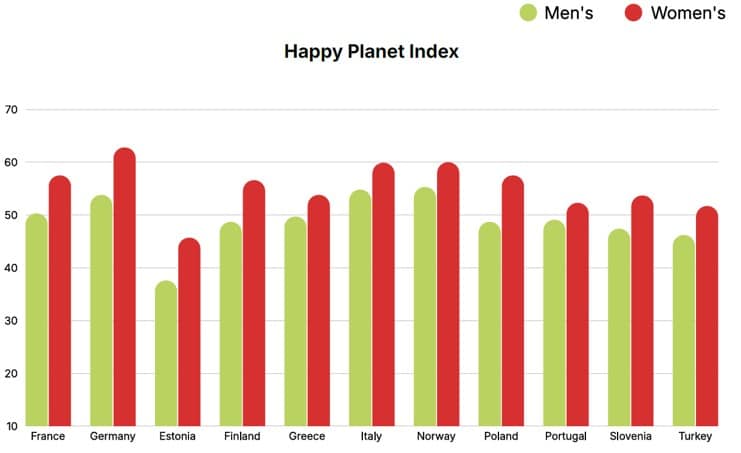
Figure 2: Individual HPI scores of women and men in 11 European countries, 7th edition survey. For details, consult the full report.
Bringing the HPI into schools
The webinar also launched the HPI’s next chapter: educational materials that introduce the HPI to children aged 11 to 13. So far, the Beyond GDP movement has made few inroads into education. Global Footprint Network is a notable exception: for over two decades, it has developed teaching materials and tools that help schools and universities measure and manage their Ecological Footprint (see educational resources). The HPI materials will add a complementary perspective by connecting our use of the planet’s resources with human wellbeing. The first pilot will take place in spring 2027 in schools in Germany, England and Wales.
Schools are essential spaces for questioning established ideas of progress and exploring alternative economic models. In the classroom, the HPI can:
- spark curiosity about the planet and how people live around the world
- show students what different lifestyles cost the planet, using the Ecological Footprint
- invite them to think critically about what could be different
- nurture the values a fair and sustainable transition needs, and
- strengthens their sense of agency.
In essence, the HPI brings home a simple idea of global justice: everyone deserves a fair share of our planet’s limited resources.
We owe future generations more than economic growth. We owe them a world where people and the planet can thrive together. They will inherit the responsibility of caring for the Earth, and we must give them the knowledge, values and tools to do better than we have. Because a good life should not cost the Earth.