


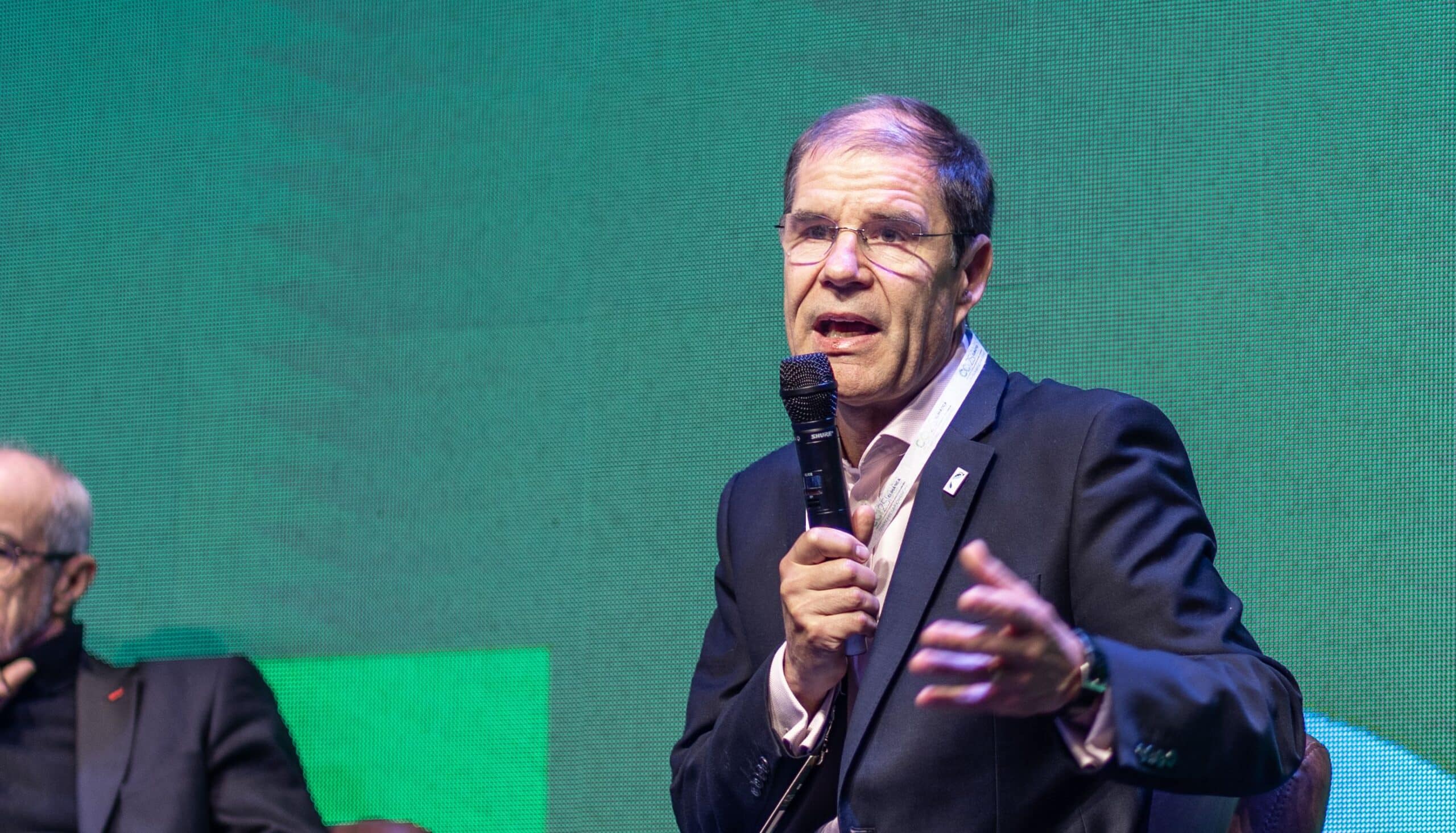
Interview of Global Footprint Network co-founder Mathis Wackernagel by Silvia Tschui, NZZ Sustainable Switzerland
Published July 29, 2026 (in German)
Original in German: sustainableswitzerland.ch/artikel/ein-leerer-kuehlschank-macht-uns-mehr-angst-als-ein-voller-abfallkuebel-id.7129
Mr. Wackernagel, you say the biggest problem in the climate debate isn’t a lack of knowledge, but the way we talk about it. What do you mean?
We almost always tell the story the same way: “The world is doomed, and it keeps getting worse. Give up your privileges so the world can be a little better off.” That makes people think: why should I give up my advantages if things in the world just keep getting harder anyway? That narrative doesn’t inspire action.
But isn’t it true that we need to cut back on our consumption?
Sure, but the first thing everyone tells themselves is: why should I eat less meat, heat less, and fly less, when my neighbors don’t and entire industries are causing enormous CO₂ emissions and my own contribution doesn’t make a difference anyway? Why should I bother if the benefit goes to everyone else while I only bear the costs? The moral story of necessary individual sacrifice, wagging the moral finger, rarely produces action. More often it produces defensiveness and cynicism. Remember Al Gore’s film?
Yes, “An Inconvenient Truth.” It was about climate change and what should be done. Why do you bring it up?
The film itself was compelling, but the title reflects a deeper problem. An “inconvenient truth” implies that knowing something is a burden. We should be showing instead that knowledge is an advantage. Anyone who understands what’s coming can prepare for it. Anyone who ignores it does so at their own risk, while those who use that information and prepare benefit.
People are more shaken by their empty fridge than by their overflowing trash bin. If you tell the story of climate change and overshoot from that angle, from resource scarcity, or simply from the empty fridge, everyone understands why the information matters to them personally. It’s about me and my own advantage, not just about other people and the world in the abstract. It’s a bit like compulsory schooling.
Compulsory schooling? Now you’ve lost me…
At some point Switzerland agreed on compulsory education for all children, because society realized it couldn’t afford to have a largely uneducated population. That cost a lot of tax money, and for some families it meant a short-term economic loss, since their children’s labor was no longer available. But imagine how far behind Switzerland would have fallen economically if, as a society, we had said, “oh, let’s wait until all the countries around us introduce compulsory education first, and stay uneducated until then.” Yet that is exactly what we do with resource questions: we wait for others to act first, often arguing that we ourselves are “only” a small country or a small company that can’t make a difference anyway.
In fact, it’s the other way around: waiting for others is itself a disadvantage. If others don’t prepare for the consequences of overshoot, we become even more vulnerable. So the less others do, the more essential it becomes for us to take the situation seriously. The self-interest that cities, countries, companies, and individuals have in preparing is actually much greater than current discourse suggests. Whoever recognizes the facts and prepares gains an advantage, regardless of what others do, and even more so if others do little.
Let’s stay concrete: what does that mean for a country like Switzerland?
Switzerland currently needs roughly four times more resources than its ecosystems can regenerate. About 70 percent of our footprint comes from CO₂ emission alone. So far we’ve made up the difference with our purchasing power: we simply buy what we’re missing. The question is whether that’s a stable strategy. Other countries, China for example, are increasingly focusing on their own resource security, and relative to us, have growing incomes, meaning they are becoming more competitive as they participate in the market to buy resources. Over the past 30 years, the relative purchasing power of the average Swiss resident compared with the average world citizen has actually fallen by around 30 percent. If access to foreign resources becomes tighter and more expensive, that’s a real risk for us, and not at some point in the future. It’s a risk already.
So what should Switzerland actually do?
I deliberately don’t say what Switzerland “should” do. As soon as you lead with “should” or “must,” usually nothing happens at all. When a country recognizes on its own that it wants to prepare, the odds that something actually happens are much higher. That, ultimately, is exactly the point of our new country report: not to lecture countries, but to show them what is in their own best interest.
And for companies, are there concrete examples?
Yes, we launched an initiative called “Power of Possibility.” There we’ve gathered more than a hundred case studies and calculated, for each one, how many days Earth Overshoot Day would shift if a given solution were applied worldwide. One of our analyses, done with Schneider Electric, a global electrical equipment company with more than 40 billion Swiss francs in annual revenue, shows that with existing, off-the-shelf technologies alone, for buildings, industry, and power generation, Overshoot Day could shift by at least 21 days worldwide, with no loss of comfort or productivity. Schneider Electric contributed several concrete examples for this, among them a highly energy-efficient office building in Grenoble and an electrified bus fleet in the United States. Calculations like these show that such innovations pay off not only in the long run, but in the short run too.
And for individuals?
For them too, it’s worth asking: “What’s in it for me?” Orient yourself around the question, “What is going to become valuable?” and “How do I personally benefit in the long run from taking action, and how do I prepare?” The nice thing is that many interventions ripple outward and reinforce one another. What serves me best has most likely also the highest chance to reduce overshoot for all.
That seems quite abstract to me. Could you give a concrete example?
Sure. Put simply: if it’s possible for you to ride a bike instead of driving a car, you’re not only helping your health, you’re also saving money, including on the gym membership, and often even saving time if you live in a city. And you avoid hassle: no parking problems, no scratches, no insurance headaches, no repair shop. And on top of all these advantages, you’re saving CO₂ as well. But you can also become a pioneer. Imagine you own a house and, during a renovation, install a large cistern that collects rainwater from your roof. In an era of heavy rain and drought, you’re storing water you can use to irrigate your garden during dry spells. Not only can you then still harvest your own tomatoes and plums while your neighbor’s have long since withered under a tap-water irrigation ban, your garden also has a cooling effect on your surroundings. Insects still find water and nectar because something is still blooming at your place, so they survive the dry period and go on to pollinate your tomatoes again next year. Birds still find food there because the insects are still around. And during thunderstorms, you take some of the load off the sewage and drainage systems, which increasingly reach their capacity limits during heavy rain, helping to prevent flooding. Your future water bill will also be lower, which helps pay back your investment over time. In this way, you build up a whole range of experiences with positive effects, not just for yourself but for other people, for nature, and for the infrastructure around you. That alone, of course, won’t solve overshoot. There’s an English expression, “death by a thousand cuts.” Maybe it’s more useful to think in terms of the opposite: “life by a thousand band aids,” i.e., a better future thanks to a thousand small fixes.
Are you personally an optimist or a pessimist about humanity’s future?
Neither. I’m an engineer. I don’t think in those categories, I calculate. Like with a bridge. Is it strong enough? For ho many trucks? For me personally, it helps just to live in a way that feels right: I ride my bike, we have solar panels on the roof, we live in a mild climate here in Oakland, California, and I bake my own bread. I feel good, and I don’t feel especially exposed on resources. I actually feel sorry for people living in suburban McMansions, whose lives depend on enormous flows of resources. Their properties are going to lose value. What fascinates me most is how obvious the problem really is, and how little we still respond to it. Sometimes I feel like a teacher standing in front of a class of gifted students who are all about to fail the exam. At some point you start to wonder what you yourself explained wrong, which is why I focus my energy on figuring out how to communicate overshoot and climate information in a way that’s framed around people’s own advantage.